In information science, an ontology encompasses a representation, formal naming, and definitions of the categories, properties, and relations between the concepts, data, or entities that pertain to one, many, or all domains of discourse. More simply, an ontology is a way of showing the properties of a subject area and how they are related, by defining a set of terms and relational expressions that represent the entities in that subject area.Every academic discipline or field, in creating its terminology, thereby lays the groundwork for an ontology. Each uses ontological assumptions to frame explicit theories, research and applications. Improved ontologies may improve problem solving within that domain, interoperability of data systems, and discoverability of data.
...In the 1980s, the AI community began to use the term ontology to refer to both a theory of a modeled world and a component of knowledge-based systems.
...Examples
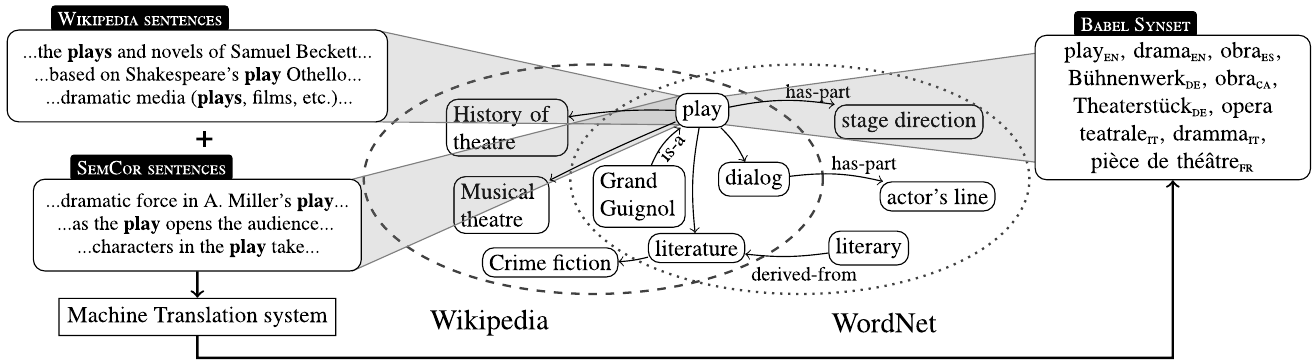
Arabic Ontology Wikipedia...a multilingual lexical-semantic knowledge graph, ontology and encyclopedic dictionary developed at the NLP group of the Sapienza University of Rome under the supervision of Roberto Navigli.[1][2] BabelNet was automatically created by linking Wikipedia to the most popular computational lexicon of the English language, WordNet....a linguistic ontology for the Arabic language, which can be used as an Arabic WordNet with ontologically clean content. People use it also as a tree (i.e. classification) of the concepts/meanings of the Arabic terms. It is a formal representation of the concepts that the Arabic terms convey, and its content is ontologically well-founded, and benchmarked to scientific advances and rigorous knowledge sources rather than to speakers' naïve beliefs as wordnets typically doBabelNet Wikipedia
...an encyclopedic dictionary that provides concepts and named entities lexicalized in many languages and connected with large amounts of semantic relations. Additional lexicalizations and definitions are added by linking to free-license wordnets, OmegaWiki, the English Wiktionary, Wikidata, FrameNet, VerbNet and others
By Robykiwi - Own work, CC BY-SA 3.0, https://commons.wikimedia.org/w/index.php?curid=26041959
CIDOC Conceptual Reference Model Wikipedia
...an extensible ontology for concepts and information in cultural heritage and museum documentation. It is the international standard (ISO 21127:2023) for the controlled exchange of cultural heritage information.
Linguistic Description Wikipedia
WordNet Wikipedia
...a lexical database of semantic relations between words that links words into semantic relations including synonyms, hyponyms, and meronyms. The synonyms are grouped into synsets with short definitions and usage examples. It can thus be seen as a combination and extension of a dictionary and thesaurus. Its primary use is in automatic text analysis and artificial intelligence applications....The database contains 155,327 words organized in 175,979 synsets for a total of 207,016 word-sense pairs; in compressed form, it is about 12 megabytes in size.[3] It includes the lexical categories nouns, verbs, adjectives and adverbs but ignores prepositions, determiners and other function words. Words from the same lexical category that are roughly synonymous are grouped into synsets, which include simplex words as well as collocations like "eat out" and "car pool." The different senses of a polysemous word form are assigned to different synsets.
Discovering the Semantics of Keywords: An Ontology-based Approach Mauricio Espinoza et al. (pdf)
...ontologies are specifications of con- ceptualizations
Ontologies Palantir
...An ontology is an artifact which stores ontological resources or entities, including the following:We call these resources Ontology resources. An ontology can either be private and assigned to a single organization or shared among multiple organizations.
- Object types
- Link types
- Action types
- Interfaces
- Shared properties
- Object type groups
Ontology vs Taxonomy: What Is the Difference? topquadrant.com
An ontology defines not only concepts but the relationships between them, showing how data, entities, and ideas interact. This makes ontologies crucial for AI models, semantic search, knowledge graphs, and enterprise systems where context and meaning are essential.A taxonomy, by contrast, organizes information into a simpler hierarchical structure, where each concept fits within a single category. Taxonomies are powerful for classification and navigation, helping users group and locate information efficiently.
Ontology: A Difficult Keyword David Bond and Lucas Bessire (2014)
Ontology is hard to ignore in contemporary anthropology. From conference abstracts to journal word clouds and job descriptions, ontology is fast becoming a new keyword in marquee debates as well as in the unfolding identity and direction of the discipline. Yet, as even the most sophisticated participants and observers soon realize, the word itself is elusive and polysemous. It holds in unresolved tension diverse semantic genealogies, opposed spatiotemporal scales, and various materialist registers. This animating tension couples profound insights with lively disagreements. At the very least, perhaps we can all agree: Ontology is an instrumentally difficult word.
full text (pdf)
15II26
some searches re: the lexicon-ontology relationship
Ontology and the LexiconOntologies and lexicons enjoy a complex relationship. Although words denote concepts and concepts make up ontologies, a lexicon is at best an ersatz ontology: there is no clear mapping between the words and word relationships that it contains and the concepts and concept relationships in an ontology. The reasons for this include the following: Word senses overlap in complex ways; many concepts are not lexicalized in some or all languages; and languages make semantic distinctions that are not ontological. Nonetheless, a lexicon can sometimes be the basis for the development of a practical ontology.Lexicon, Ontology and Text Meaning B Onyshkevych (1991)
Ontology and Lexicon: The Missing Link Fadi Badra et al.
Ontology and the Lexicon: A Natural Language Processing Perspective
Ontologies, text and the lexicon N. Aussenac-Gilles (pdf)
...The main difference between an ontology and a lexicon, lexical database or thesaurus is that all of the latter are linguistic objects while ontologies are not (they are logical theories). (Ciminao, Volker, Buitelaar, 2010)Lexicon Model for Ontologies: Community Report, 10 May 2016 (Ontology-Lexica Community Group)
Semantic Model vs Ontology vs Knowledge Graph: Untangling the latest data modeling terminology Cassi at Medium
22ii26
Knowledge Graphs and Ontologies: Beyond the Dictionary Fallacy Nicholas Figay 18x25
...An ontology, in its philosophical and formal sense, is not merely an inventory of what exists; it is the science of being itself — a rigorous formalization of the fundamental categories and relationships through which a domain makes sense. It seeks to answer: What is the essential, coherent structure of this domain?...Knowledge is never solely the result of isolated perception. It emerges through a dynamic movement from the individual (tacit knowledge, context-bound intuition) to the collective (shared formalization, domain expertise, collective validation). An ontology is the formal expression of this shared understanding — stabilized, teachable, independent of any single practitioner, yet always situated within a specific domain.
...The ultimate failure of the "dictionary fallacy" is that it forces us to formalize the world only in terms of static description. To be truly adequate, ontologies must be grounded in a philosophy of action.
An adequate ontology must formalize not merely what exists, but how a domain functions — what agents can do, what constraints govern possibility, what purposes drive choices, and how knowledge enables or limits what is possible. This is not an extra layer; it is the substance of the ontology itself.
...This fundamental reorientation — from treating ontologies as mere data infrastructure to seeing them as philosophical frameworks for collective understanding and coordinated action — is what ultimately transforms knowledge graphs into genuine instruments of complex organizational function.
4iv26
Does an Ontology need an Interpreter? Dean Allamang at Medium
For a number of years, I worked on an industry model called FIBO — the Finance Industry Business Ontology. The vision behind FIBO was that we could specify, at a business level, the entities and relationships that describe data for all aspects of the Finance industry. If possible, we'd want to do this in a technology-agnostic way, describing business entities, not technical ones.FIBO is expressed in OWL, the Web Ontology Language. An advantage of using OWL is that it is fundamentally a form of logic; you can prove that your models are consistent, and you have a formal definition of what any construct in the language means. This is great for having an unambiguous representation of a model
...could GenAI make FIBO more understandable, more useable, and, eventually, more successful?
...An AI assistant can discuss the subtleties of FIBO knowledge — drawing on the actual model and structure — and match that knowledge to real questions from real users. It can carry on follow-on conversations, fielding the kind of probing, iterative questions that a thoughtful practitioner will ask. That's a very different experience from staring at a list of thousands of classes and trying to figure out where to start.
FIBO is one example of a highly curated domain, but it is far from the only one. The history of knowledge engineering is peppered with ambitious ontology projects that solved the supply-side problem — building a precise, comprehensive, carefully maintained model — without ever solving the demand-side problem: getting practitioners to actually use it. The Open Biological and Biomedical Ontology Foundry alone includes hundreds of curated ontologies covering life sciences and medicine, from gene function to disease to drug mechanisms. These are exactly the kinds of resources that should be transforming how researchers and clinicians work with data. And yet the "out of the box" experience problem is endemic to formal ontologies in general; the care and precision that makes them valuable is precisely what makes them inaccessible to someone without specialized training.